
Insights7 min read
How Competency Management Improves Compliance and Closes Skill Gaps
Utkarsh Raj
Every regulated organization has to prove its people are competent — to auditors, to clients, to insurers, and to regulators. Almost none of them can do it on demand.
Instead, proof gets assembled: a spreadsheet here, a folder of scanned certificates there, an email thread where someone confirms a technician was signed off in 2023. The audit eventually passes — after weeks of administrative effort, and it still tells you nothing about the capability of your workforce today.
- Records That Describe the Past
- A crew change is due on Friday. The certificate that clears one engineer to sail expired last month, and nobody saw it — the reminder lived in a spreadsheet that stopped being maintained when its owner moved to another role. The vessel sails a person short, or it sails non-compliant. Both outcomes were predictable.
That is not carelessness. It is what happens when compliance-critical data lives in tools that were never designed to enforce anything.
Spreadsheets have no memory and no owner. A workbook tracking 400 certifications is accurate on the day it is updated and decays from that moment: no audit trail, no validation against a typo, no escalation as a deadline approaches.
Documents are storage, not evidence. A scanned PDF proves a certificate existed. It does not prove it is current, that it matches the role the person performs, or that the assessment behind it followed a standard. Auditors ask for the second thing.
HR systems track employment, not capability. They model job titles, contracts and leave — rarely the difference between what a role requires and what an individual has demonstrated, which is the gap that matters.
Assessment quality varies by assessor. Without a defined scale and mandatory evidence, “competent” means whatever the assessor meant that day.
The bill arrives somewhere else. A certification lapses mid-voyage and port state control detains the vessel — days of lost charter, not administrative inconvenience. A hospital cannot confirm who holds current advanced life support certification, so it over-staffs every shift. A contractor cannot produce its ratio of certified welders from live data, and bids cautiously or withdraws. In each case the organization probably was compliant. It simply could not prove it fast enough for the proof to be worth anything.
- Why the Bar Is Rising
- Regulators have shifted from record-keeping to demonstrable assurance. ISO 9001 and ISO 45001, IMO and STCW requirements in maritime, and sector regimes in aviation, energy and healthcare all now ask for a systematic process for evidencing competence rather than a filing cabinet of certificates. Clients audit their suppliers too, which moves competency data from a back-office concern to a commercial one.
What each approach can and cannot do Capability Spreadsheets and shared drives Generic HRIS or LMS Competency management system Single source of truth No — copies proliferate Partial: employment data only Yes Role-to-person gap analysis Manual Rarely supported Automated Certification expiry alerts Manual reminders Basic, often per course Continuous, with escalation Evidence attached to ratings Loose files Course completion only Structured and linked Audit trail of changes None Limited Full history Audit report generation Days to weeks Partial extract Minutes Cross-site standardization Depends on discipline Job titles only Governed frameworks The pattern is consistent: existing tools capture activity — a course was completed, a document was uploaded — but not capability, which is that this person meets this standard and here is why.
The cost of that gap is never on one line of the P&L, which is exactly why it persists: administrator-weeks of audit preparation each cycle, delayed crew changes and detained assets, training budget spread evenly because nobody can identify the real shortfalls, bids not made for lack of provable capability, and external hires for skills already in the building but invisible. Meanwhile managers spend their time administering records rather than acting on them, and employees cannot see what their next role requires — which quietly costs retention among exactly the people you most want to keep.
- One Standard, Measured Continuously
- A competency management system starts from a simple premise: every role has a defined standard, and every person is measured against it using evidence. That standard — the skills, qualifications, experience and certificates a role requires — is defined once, governed centrally, and applied across every site, vessel and department, so “qualified” stops being a local interpretation and becomes an organizational definition.
Assessments become defensible. Assessors work from a defined scale with evidence attached, so a rating is a record you can present under scrutiny rather than an opinion you defend from memory.
Certificates become self-monitoring. Issue and expiry dates are structured data, so renewals surface weeks ahead with escalating reminders — rather than on the day they lapse, or after.
Gaps become visible and quantified. The difference between what a role demands and what a person holds is calculated continuously, turning training from a budget-cycle habit into a response to measured need.
Because all of it sits on one dataset, the skills matrix, the compliance dashboard and the audit evidence pack are simply different views of the same live information. Nobody reconciles versions.
The same six questions, asked of both approaches Dimension Traditional approach Competency management Data currency Accurate on the day it was updated Current by design Audit preparation Weeks of document retrieval Report generated on demand Skill gaps Discovered during incidents Calculated continuously Training decisions Budget-driven, evenly spread Gap-driven, targeted Compliance posture Periodic scramble Continuous, demonstrable state Internal mobility Informal, relationship-based Searchable by capability What That Looks Like in Practice
- Harmonizing technician grades across twelve facilities — surfaced two sites that had been signing off work at a materially lower standard than the rest.
- Covering an unplanned absence — takes a supervisor under a minute to find three qualified internal candidates, instead of four phone calls and a guess.
- A client audit — is answered with the full assessment trail for a named engineer — scale, evidence, assessor, date — while the auditor is still in the room.
- One gap analysis — found a critical certification held by two people approaching retirement: a succession risk no headcount report would ever show.
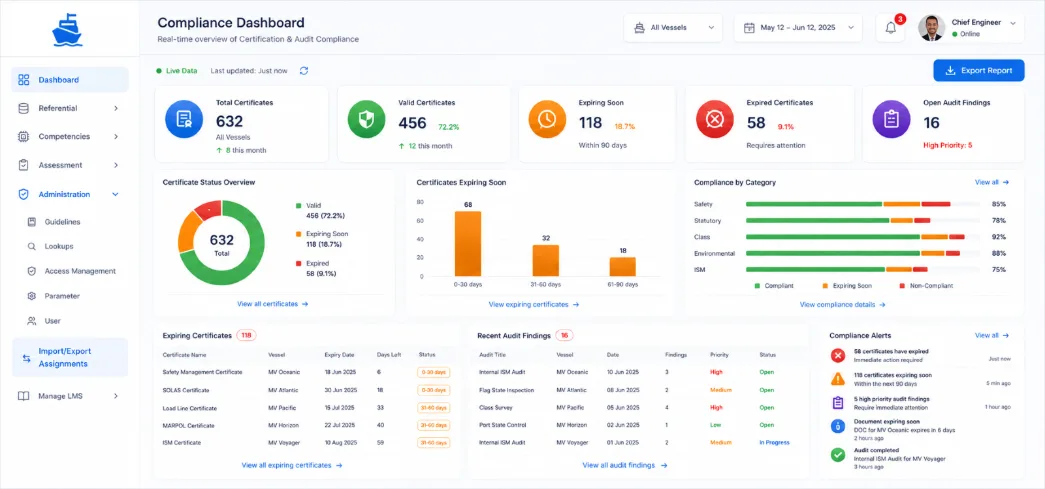
What “generated rather than assembled” looks like: totals, expiries and audit findings as views of one dataset. Illustrative of the shape such a view takes — not a screenshot of a shipped product. - Why This Changes the Argument
- The shift is not that records become digital. It is that competence stops being something you reconstruct and becomes something you can observe.

The same problem in six regulatory regimes. What changes between them is the standard being proved — rank certifications at sea, authorized-person regimes in energy, recurrent checks in aviation — not the difficulty of proving it. Compliance becomes a state, not an event. When evidence is always current, the audit is a query rather than a project.
Capability becomes strategic data. Structured and queryable, it informs decisions previously made on instinct: where to open a facility, whether to bid, whom to promote, which skills to build versus buy.
Risk moves upstream. Gaps arrive as forecasts — a certification cluster expiring in Q3, a critical skill held by two people, a site drifting below standard — rather than as incidents and detentions.
What comes next is already visible: skills replacing job titles as the unit of workforce planning, AI suggesting training paths with human assessors keeping final sign-off, evidence captured during normal work instead of at an annual review, and digitally verifiable credentials that make checking a new hire instant. Organizations already running structured frameworks will absorb those changes as configuration; those on spreadsheets will absorb them as projects.
Baseline five numbers before you start: audit preparation time, certification lapse rate, training spend precision, time-to-fill for internally coverable roles, and the manual administration your supervisors absorb. That is where the return shows up first.
In closing
Expired certificates, invisible skill gaps and week-long audit scrambles are three symptoms of one condition: compliance data that describes the past instead of the present.
Competence is only as valuable as your ability to prove it. Bring skills, assessments, training and certifications into one place, and compliance stops being a periodic scramble — it becomes a state you can demonstrate at any moment, to anyone who asks.